Monday, 28 April 2014

A Lack of Imagination

The Insular Cortex (Soure: wikipedia) where consciousness happens.


I have been thinking about imagination, and about how some doors of imagination are closed to me. I’m a writer. Imagination is my thing. Metaphors, similes, creating new worlds and people to go in them. But other people’s imagination is another ball game (look, there’s a metaphor, and not even one I really like.) I like this item of food, so why don’t you like it? I believe in this political viewpoint, so why, even if I explain as clearly as I can, won’t you agree with me? Why won’t you believe what I know is the truth? Why doesn’t your mind think like mine? I can try to see it as I would see it if I were you, but not as you would see it without my involvement.

I am a literature graduate and I love well written fiction with a passion. But I find it very hard to imagine other writer’s worlds in my head. This is a hard thing for a writer to admit to. When I read a book I almost never see the faces of the characters. Even when I write I can’t see the faces of my characters. People are harder to visualise than surroundings, but with some writers surroundings are almost impossible too. Jane Austen, I have found, is almost impossible to visualise. When I read Emma many years ago I couldn’t visualise Emma’s world. She was forever walking up and down a street that was something like a film set with nothing behind the fronts of the houses. Austen describes minds, not places.

'The Reader Wreathed with Flowers,' Camille Corot (Soure: Wikimedia)
I can get lost in a well described environment. I remember reading The Long Winter once and looking up astonished to find that there was bright summer sunshine outside, not a blizzard. But still the characters’ appearances are a mystery, no matter how well described. Characters have hair and dresses and physical actions, but they don’t have faces. A good film adaptation is a blessing, because then I have something to fit in my mind to characters which would otherwise be an amorphous grouping of described features, something like a late Picasso painting. I might hear a description of a nose, of eye colour, of high cheekbones, but these things are a jumble in my mind.

Extend this, and I find it very hard to keep a number of characters in my head. All these names that don’t really have faces are jumbled around in my mind as I read each page. I find it hard to remember names and fit them to faces in the real world, so in a book where I have never been presented with an actual physical image of that face is nigh on impossible. Imagine the time when I was walking to the school with my husband. He waved and greeted someone. I asked him in a low voice who it was and he told me in a bemused voice that it was the man who lived across the road from us. I recognise him in the street outside his home, but I’ve never seen him on that path before and so he was a stranger. I couldn’t tell you his name if I tried. I’m having trouble recalling his wife’s name right now, someone I speak to often on the school run. It’s something Welsh and I know it isn’t Gwen. That’s it. The further people are away from me in lifestyle, tastes, habits, the harder I find it to remember their details. (Don’t get me started on remembering their contact details. I still can’t even remember my own home phone number.) So give me, say, sixteen people in a novel whose faces I cannot see and names I struggle to remember, and I’m lost.

Members of the group "Anonymous" (Source: Wikipedia)
Of course this lack of social imagination has an impact on my interactions with the real world. Other people seem to be part of a web of communication from which I am excluded. This has gone on all my life and I feel it as soon as I’m in an arena where I need to pick up those vital bits of information that people share with each other. ‘Oh, you know Betty?’ someone says. I shake my head. ‘You know, Sarah’s mother. Sarah’s in George’s class.’ I shake my head again. I have no idea. These people mill around and if they have particularly pleasant or unpleasant personalities their faces might start to stand out. (I have to admit, I remember the faces of those people I see as threats far better than those I see as friends.) If they talk to me a lot I might start to remember their name and I know the names of my children’s friends, but no further. There’s a network of gossip, discussion, information sharing, whatever you want to call it, but I always seem to be on the outside.

What does all this mean? I don’t take people away with me in my head. When I leave my children at school I am aware of their existence, of course. I love them, and if there’s something specific that has them upset I might worry about them, but essentially once I turn away from the door I could be childless. I don’t look ahead to the moment of picking them up. In that moment I could be childless for the rest of my life. I don’t have a good memory for what happened last week or a good concept of what might happen next week. Things happen a day at a time. So I don’t live with the thought of other people in my mind, not unless they’re making noise, poking me, in some way invading the bubble of my mind. That, perhaps, is a lack of social imagination. I have six or more novels under my belt, but I can’t see the faces of any of my characters. I have read hundreds of books, and the characters are a cannibal’s assortment of noses, eyes, legs, and hair. This is how my mind works.


Wednesday, 16 April 2014

On Asperger's and Sensitivity

The last time I posted I spoke very briefly about being an HSP mother. I promised to save that for next time. I've known that I was an HSP for a good many years, but recently my self assessment has changed. HSP stands for Highly Sensitive Person, and if you want to find out more about that then Dr Elaine Aron's site is the best place to go. 

If the phrase 'Highly Sensitive Person' sounds like it should be surrounded by daisy chains and auras perhaps it's because it often is. If I have to hear the words 'are you an indigo child?' one more time I may scream. I'm not saying all HSPs are like that, but you get an awful lot of it.

The perfect retreat - as long as they don't know I'm in there.
I am HSP. I have all of the problems of being HSP. The overly sensitive skin, hearing, sight. The intolerance for chaos and noise. The sensitivity to chemicals and insect bites. Ant bites turn into huge red weals. The last time I was stung by a bee I went into anaphylaxis. Then there's the social sensitivity. The need to frequently withdraw from other people and be totally alone. That's why I'm currently lying in a tent with a blanket over my head. The screaming and bickering of three small children is enough, but it's not just that that fills me up. It's the constant little nudges. The questions, the touches, the inability to go anywhere alone. The constant kisses that make nausea rise in me. The constant sensory stimulation is just too much. I start to feel as if my mind is spinning and coming apart. I want to scream and hit them away. Of course I don't. At least, I try to control it, although I can't promise not to snap.

But recently I have grown to realise that it was more than that. It's not just being an HSP. It's actually Asperger's Syndrome.

My problems in fitting in with other people go way back. I've always had few friends or no real friends. I can't say 'I love you' to anyone but children and animals - not without a great deep down questioning of what love is and if I really feel it. I can't sit in a room and talk to a person, even a close friend, without intense anxiety and self-reflection and analysing every sentence. I can barely talk on the phone. I constantly feel as if I'm missing social cues, misreading people's reactions, coming in at the wrong point or failing to come in at all. I go away from these interactions feeling drained and full of self-hatred for my inability to connect, to just do what other people do, and sit down and talk. I want to connect with people. I really do. It just doesn't work out. It's especially hard when every new place and situation sends me into a kind of shutdown, when visiting a place that I haven't been to before leaves me with intense anxiety and moving house makes me need to hide in bed for a week with physical weakness, diarrhoea, and an inability to think straight.

Often I don't know who I am.
I think I've heard every stock response since my self-diagnosis. 'You can't have Asperger's, you're too empathic.' 'I knew someone with Asperger's and you're not a bit like her.' 'You're just trying to explain your reaction to a difficult childhood.' Conversely I've had a couple of supportive friends - one with Asperger's herself who had suspected that I had it, another who is a learning disabilities nurse who suspected the same, another who read through the symptoms after her initial doubts and agreed, yes, that was me summed up on paper. These friends are like a balm and make me feel less like I'm losing my mind or being a hypochondriac. One of the problems with Asperger's is a lack of a sense of identity. If I watch a film or read a book or am exposed to a certain strong identity I take it on, chameleon-like, and so I am left constantly questioning my motives and from where my feelings have come. I worry that I am too empathic to have Asperger's, but empathy in Asperger's is a hot potato all of its own. There is a current line of thought, which seems upheld by most of the aspies I have met, that people with Asperger's actually feel too strongly, and so shut down and have difficulty in processing their emotions. We grow attached to inanimate objects even more so than bewildering human beings. This explains why I grieved for almost eight years about moving home, sobbed when we got rid of our broken television and settee, and still dearly miss the car we had when I was growing up. It explains why when someone comes at me with a hug or a kiss I feel as if I'm in the path of an oncoming train, and why I can't say, 'I love you' without deeply analysing what it means to love. Love is too important a thing to miscommunicate to someone who means the world to you.

It's extremely difficult to pursue a diagnosis of Asperger's if you're female and on the NHS (at least in this part of the country, where they just don't seem to have the resources.) Females with Asperger's syndrome are exceptionally good at coping mechanisms, it seems, at papering over the cracks and fitting in to a neuro-typical society. My case has been summed up as 'everyone finds life hard,' and dismissed because I'm a writer, capable, it seems, of empathising with my characters and using metaphor. Language is my 'thing.' It's what I do well - written down, at least. Spoken, it's a different matter. But all of the online tests agree. All of my contact with other people with Asperger's agrees. My resonance with their experience agrees. All the little seemingly unconnected things in my life agree with the traits set out for females with Asperger's. Reading Tania Marshall's highly detailed list of female Asperger's symptoms is like reading a biography.
Part of a series of earthenware figures I made as a teenager,
exploring loneliness, empathy, and family relations.

But what does all this mean for me? It means that things that aren't symmetrical make my brain itch and most of the time I wear no more than a t-shirt because clothes drive me crazy. It means that messages in my inbox go unanswered because the more important they are the more anxious I am to get the reply exactly right. It means that I don't see good friends for years because the thought of meeting up with them and opening up social interaction is terrifying. It means that I barely talk on the phone except to my family. It also means that often I am shut off and unaware of other people's problems. It means that when I am aware of them I am desperate to help them 'fix' it and get back to the status quo. It means that sometimes I say things that are too blunt or too focussed on solving the problem rather than simple reassurance. (If I give you simple reassurance it's likely that it's a learned habit. Coming from a family with deep mental problems I've had a lot of practice at that.) It means that I suffer from depression and anxiety and the urge to self-harm in order to get some control over my life. It means that I love my children dearly, but that I get touched out, overwhelmed, in desperate need of alone-time.

Not my most organised shelves. I mostly just love
the aesthetics of this.
It also means good things. Obsessions with television programmes and characters that have immeasurably improved my life and brought me many online friends. True it means that I spent a good portion of my teenage years having meltdowns at equipment failure when watching Star Trek, and that I have spent a lot of the past few years sobbing over the death of Peter Graves and the fact that my favourite character left the tv show Route 66, way back in the early sixties. But these obsessions bring me a huge amount of joy. Writing fanfiction taught me to write novels. Needing all of my dvds and cds to be ordered by alphabet and genre means that I can find what I want when I want it. I don't lack things to keep my mind occupied because I have to watch every episode of my current obsession in order, or I have to read every single book on the latest 'have you read this?' list regardless of personal taste. I like to answer questions and find out as much as I can about the world. I see things at a different angle, and I feel that I see them better for that.


Having some kind of diagnosis, albeit a non-professional one, has helped me to make sense of my life. It's made me feel like less of a broken human being. When my sympathy span is short if my children have hurt themselves I know it's not just because I'm a despicable human being. When I need to get away from the touching and kissing it's not because I'm cold. And when one of my sons has his own meltdowns over the wrong trousers or being misunderstood or a hundred seemingly insignificant things I can understand that it's probably because this runs through the family (I can see it in various family members) and he's not just being precious. He has real, valid fears and concerns. For the first time in my life I have a connection with people who think and feel like me and understand the issues that I face in life. The hardest thing is being 'out' to people who don't believe that I'm right about myself. The best thing is being 'out' to those who do.

Saturday, 15 February 2014

Playdough Saturday!

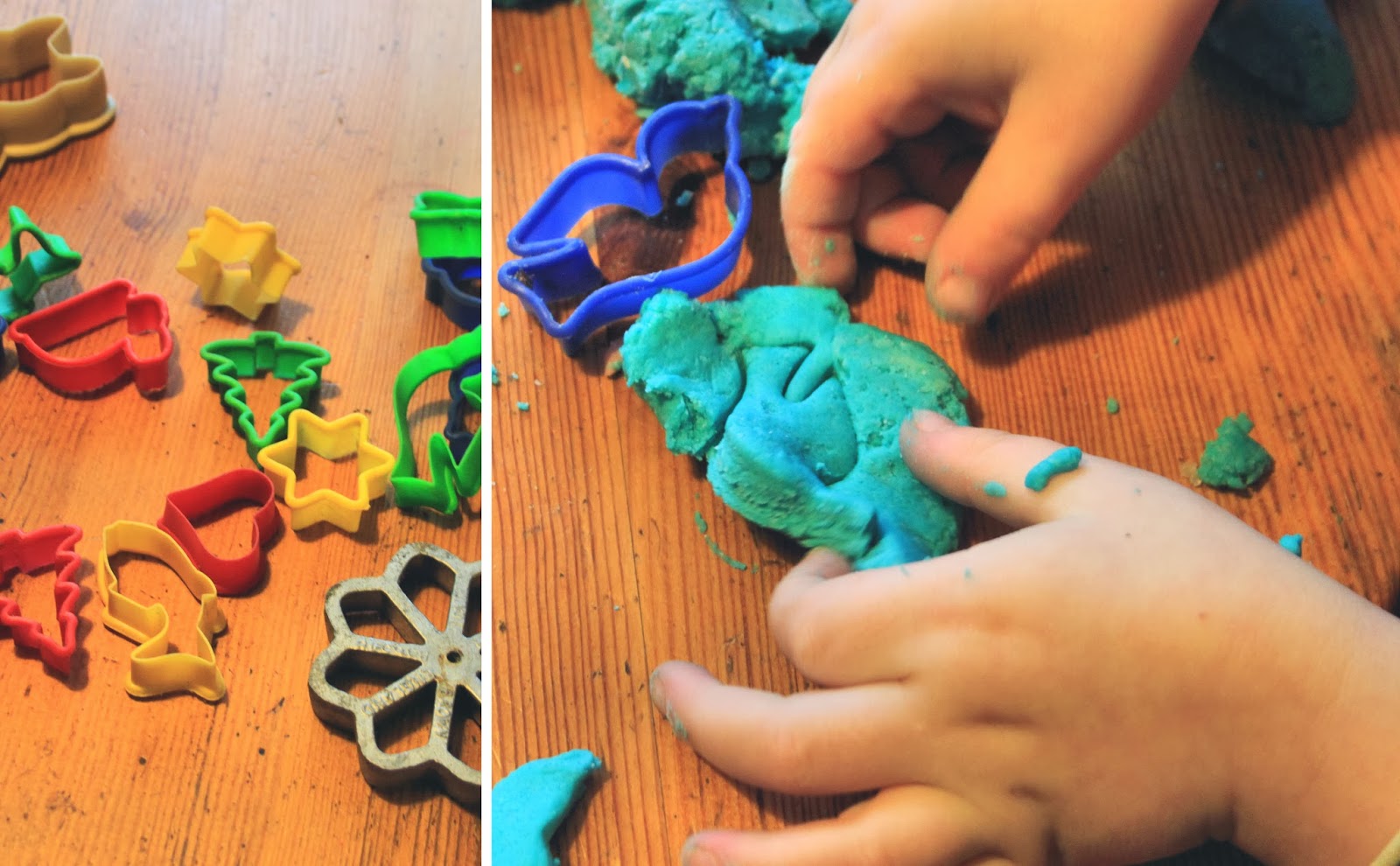
Things are always different when we're at my parents' place. They live on a four acre permaculture smallholding and for an HSP (that's a whole other blog post waiting to happen) it's so much easier for me there. This morning I felt capable of making playdough. It's been a long time. I'm not sure if I've ever made it with my children, but I have great memories of it as a child, the smell of it, the salty taste on my hands, making all sorts of shapes and things with it. Since three-year-old Ben's teacher had just recommended him playing with playdough to strengthen his hands for writing it seemed like the perfect time.

I wanted to find a recipe that didn't include cream of tartar, because I was sure we wouldn't have that in the house, and I don't remember it being in the recipe as a child. Luckily I found one on the Cbeebies site that was perfect. A bit awkward that it was in cups (and surprising for a British site) but we had some measuring cups in the drawer, so it was all good. Once we'd mixed the salt, flour, and cornflour I split the mixture in half and coloured half of it red and half blue.

The children had plenty of fun helping me make the dough, and the fun continued once it was kneaded into balls and out on the table. With the help of the cutters I used as a child and various other kitchen bits and bobs they have spent the morning making shapes, mountains, babies in cradles, graves for their Lego men (that was George. He has an interesting mind), pancakes and ice cream.

For an added bonus, while I had the cornflour out, I decided to introduce them again to non-Newtonian fluids, which flow when they're not under pressure but go hard when force is applied. We've shown Oscar and George this before, but I don't think they remembered. I mixed a bowl of cornflour with a little water and put it on the table to show them how it worked. Ben was a little freaked out at first, but Oscar and George were fascinated and George spent at least three quarters of an hour deeply engrossed in this single bowl of cornflour. Now Ben is pretending it's Mount Doom from Lord of the Rings and is digging it out onto the table.

We got a little science in with this, discovering that these fluids work as they do because on the microscopic level you have little grains of solid in a suspension in a liquid. When the fluid moves slowly the particles can move past one another, but under impact there's no time for the particles to move aside and make way, and so they behave like a solid.

Of course as an HSP parent I'm exhausted now and they're still going strong four or five hours later. There's playdough everywhere. But they're having fun, and that's what counts.


Saturday, 8 February 2014

What's Under Your Sink?

A plunger? Cleaning cloths? Bleach? Antibacterial spray? Febreeze?
'Poison' by Cavin on Flickr (license)

'Every week around 500 children under five [in the UK] are rushed to hospital because it's thought they have swallowed something poisonous.' (Source: nidirect.gov.uk)

I remember this kind of incident in my own childhood (due to berries on a blackberrying trip not household substances.) Being taken off to hospital by worried parents. Orange juice with an emetic concealed inside. Staying in hospital overnight. The high bars of the hospital cot. Even if no ill effects unfold, the repercussions of possibly ingesting something poisonous are unpleasant for both parent and child.

I want to address a fundamental strangeness in the way we organise our kitchens. To be clear, it's the way I organise my kitchen too. We have cleaning products under the sink. Pretty much everyone does. My parents do and always have, as far as my memory goes. Almost every house I've been in, when I've had cause to look under the sink, shows the same arrangement. Bleach? Under the sink. Window cleaner? Under the sink. Dettol? Under the sink.

We don't keep a lot of chemicals at home (and when I say chemicals I mean cleaning fluids and the like. Of course everything is composed of chemicals, from the H2O in the taps to the O and CO2 in the air we breathe.) Most things come clean with water or water and a little washing up liquid (Ecover if the supermarket has it.) It's best for the environment and your personal health not to rely on too many nasty chemicals. But still, I don't want my boys indulging in their own form of speakeasy on the kitchen floor.


'Chemistry Bottles With Liquid Inside,' zhouxuan12345678, cropped. (License)
Do most children show an interest in swigging bleach from the bottle or rummaging in the medicine cabinet? None of mine ever have. They're very clear on 'that's medicine' (it's all under lock and key anyway), or 'that's a nasty chemical.' They know not to touch. But Ben, in particular, loves cleaning. It's one of those things I pray he won't grow out of. He's forever rummaging under the sink and coming out with cleaning spray so he can 'help' clean up.

So why do we keep our cleaning fluids under the sink? What's the point? Why spend time fitting child locks and desperately trying to barricade the cupboard? (In our previous residence we used a stick to 'lock' the doors.) I understand that you don't want to put certain things under the sink, but there are plenty of things that could be stored there. Tinned food. Food in plastic and glass containers. That could fill a whole cupboard, and meanwhile all your horrible bleaches and sprays could be up at adult eye level, well out of the reach of little hands and mouths.

So isn't it time for a fundamental reorganisation of our kitchens, and of our mindset regarding where things 'should' be kept? Do we have to keep our bleach under the sink because Mrs Jones next door does, and so does Mr Hughes the next door down, and so do your parents, and so do your friends? Educate your children about what's safe and what's not, but if you can, keep dangerous substances out of reach.


[A little post-script. It's not only cleaning products and medicines that can be harmful. When George was younger I invited him to smell some powered ginger. Instead of sniffing he blew, and the powder billowed up right into his eyes. On that occasion we rushed him straight to A&E where the doctor confirmed that ginger was one of the most painful things you could have in your eyes. He had to have anaesthetic eye drops for three or four days afterwards. And it's not just ginger. The more obvious one is nutmeg. The ingestion of 'five or more grams of nutmeg causes acute nutmeg poisoning.' (Source: toxnet.nlm.nih.gov) Be careful with spices as well as the more conventionally 'dangerous' kitchen items! ]


Tuesday, 5 November 2013

Young Male Suicide

Max Kurzweil - Despair (Creative Commons)
A year ago, give or take a few days, a friend committed suicide. He disappeared, leaving friends and family in panic for his safety. He loaded his backpack with concrete. He left a note in his car, and he drowned himself in one of the most beautiful places in the country. No one could believe it, because he was such a fun guy. His life was played out through photos of football matches in fancy dress, travels to the most far-flung places, love of good music, an arm flung round the shoulders of friends all around the world. There was not a bad word said, and that was before he died, not afterwards.

Afterwards his Facebook page, always the news-bringer, lit up with messages of love, sadness, disbelief. Friends from around the world were in shock. He had been a great traveller, an experiencer of life, someone who seemed to grab every opportunity with both hands. He had brought joy and love and great fun to people in almost every continent, and now they were reeling.

This was a single tragedy to many people. It happened, and people moved on. They felt sadness, deep sadness, but life goes on. But 'three young males take their own life on average every day across the [UK].' Three, every day. That's over a thousand a year. A thousand young men who take themselves out of life and leave a wrack behind them, a knock on effect of grief and loss and disbelief that ripples through thousands. Too many people have stories like this to tell of the man who they never thought would do something like that, but did.
There may be light at the end of the tunnel. (G Meyer, on Flickr)

The supreme tragedy of this to me is that many of these young men aren't suffering from severe long-term depression or chronic physical illnesses. They are afraid or pressured or at the end of their tether at that precise nadir of their lives. They are in a situation that could be turned around, somehow by someone, if only there were more awareness of how these things happen. They could carry on and overcome their problems, and look back on that time as one of the worst in their life, but one that they got through. One that they survived.

I don't know how to solve this issue. I wish I did. But surely spreading awareness must be a key step. Be aware of the men in your life – especially the young ones, the ones who seem to have it all but are going through a bad patch, the ones who put a brave face on it but perhaps spend each night in fear. Please, be aware. Don't be afraid to reach out. Surely it is far, far better to offer help to someone who doesn't need it than to miss someone who does? Offer them love, understanding. Help them solve their problems. Help them realise that they don't have to go it alone.

And if you are a young man in this situation, please, speak to someone. Anyone. A friend, a doctor, a stranger at a bus shelter. Anyone. Give yourself time. We don't want you to die.

Please, save a life.

Friday, 25 October 2013

How My Children Lost Their Faith

Halloween iPhone-Desk Paper by arsgrafik on deviantArt

It's that time of year again. You know. The time that you can't mention. (Shhh! Hallowe'en.)

Yes, that time. As a Pagan – a very loose Pagan, but a Pagan nonetheless – Hallowe'en has a strong place in my feelings. It's a special time of year. I feel closer to the dead and the not-yet-living and to the threats and wonders of all of those things.

Temporary Altar by Bart Everson on Flickr
But I keep hearing reports that pupils aren't allowed to talk about this in my children's school. It sounds as if some teachers allow it, while others don't. As always with children, these things are unclear. To be honest, it doesn't bother mine much. To them Hallowe'en is about sweets – America's fault, I suppose – despite the fact that I don't get sweets out on Hallowe'en. But this discrimination does bother me.

The problem is that my children attend a faith school. I know the words 'faith school' conjure up images of extreme Muslim academies teaching small children to be terrorists. At least, the tabloid papers would have it that way. But probably most Muslim/Jewish/Church of England or other religious schools are pretty much like the Church in Wales one my children go to. A good, open, friendly school with good teaching and a great learning environment.

But there are issues. Despite some small evidence that they learn about other faiths, Christianity has a very large place in their schooling. It's the only faith that I hear my children talking about in relation to school. And recently George got into trouble during prayers. They accept him not putting his hands together and not saying the words, but he was turning his back on the teacher. I explained that I could tell him that it was rude to turn his back, and he shouldn't do it, but I couldn't force him to pray.

'But this is a Church in Wales school,' I was reminded.

Ibaraki Kasugaoka Church light cross by Bergmann
'Yes, but it's the only school in the area. We have no choice but to send our children here. And forcing someone to pray makes a complete mockery of prayer,' I reminded them.

My son's teacher, a lovely woman, thankfully acknowledged this. What would I have done if she didn't?

It seems that there's not much I could do. Religious schools appear to be pretty much exempt from discrimination laws. It's a confusing subject to research (especially with a mild migraine and a Lego-obsessed three year old in the room), and the Armchair Backseatologist has done it much better here. But the National Secular Society's page states, 'Many faith schools are granted exemptions from equality laws which are meant to ensure that schools cannot discriminate against pupils because of their religion or belief.'

There's something very wrong in this. Discrimination is discrimination. Yes, some discrimination can be positive – teaching children of different abilities differently, for example. But surely it's wrong to say to a child, 'You cannot express your faith in our school.' If their argument is that they're not celebrating Hallowe'en as a part of faith, then why is it a threat? If it is a part of faith, then surely it's wrong to suppress it? I'm sure that if that faith was Judaism or Islam they wouldn't be met with this response, but Hallowe'en straddles an odd border between Paganism and Christianity, and it apparently scares the Church in Wales. Discriminating against one particular form of faith is even worse than discriminating against them all.

There's Probably No God by Dan Etherington

The result of this attitude towards faith? Oscar, 8, not only believes there is no god, but also that Jesus never existed, no matter how much evidence there is that he was a historical figure. George's thoughts are going the same way. They have been so pushed into the Christian faith that they are revolted by it. Really, is this the way we want to introduce our children to faith? My family has a wide spectrum of views including Pagan, Baha'i, Judaism, and Christian (Church of England and Church in Wales). There's probably even some Catholic somewhere in the woodwork. I would like my sons to grow up able to choose what to believe, whether that be a religion or atheism, rather than either being indoctrinated into one faith, or so sickened by it that they cannot believe in anything.


Sunday, 20 October 2013

A Caveat On Jumping to Conclusions

This is far from how I looked, I must say.
If you walk past our house at the moment you'd see that my husband keeps me in a cage. Half-naked, the pressure of the bars leaving red marks on my skin. The door is latched but not locked. Obviously I'm too scared to leave without permission. Either that, or I'm deriving a sexual thrill from my captivity, regardless of the children in the room who are able to watch this gratuitous display. They're so inured to the sight that they don't bat an eyelid. In fact, after a time, George crawls in with me. It's disgusting to see such a display. Appalling. There are no words.

You might be tempted to call social services or the police. You might be tempted to whisper or make comments about how terrible the situation is in my house and what my children are exposed to. You might even feel like popping an anonymous note through the door telling me where I'm going wrong. People do this. I know that, because I've had it happen.

If you actually stopped and came into the house you'd be able to see around the corner of the settee. You'd see that on my chest is a large ginger cat with a severe wound on his leg and a plastic cone on his head. He's just had his shattered leg repaired with intensive surgery. There's just enough room in the cage for him (and his cushion), me, and a litter-tray, food bowl, and water bowl. I'm not actually being abused by my husband or shamelessly living out sexual fantasies in front of the children. I'm trying to help the cat heal faster by giving him comfort at what is probably a pretty terrible time for him. I'm spending a couple of hours a day with him, at the very least. It's not easy, but it's best.

Yes, this is a kind of allegory. You may wander past this blog and look in and wonder at my life. You may tell me that I and people like me 'probably all freely have sex in front of [our children]' or be 'appalled' at the fact that my life and my children's upbringing doesn't closely resemble what you believe to be best. But, as with most things on the internet, you need to remember a few things. Blog posts are rarely the sum and measure of a person's life. They don't present every aspect of what happens in a house. They are written by real people who actually exist in a real place and time. These people really have feelings. And I don't just mean me - I also mean the many other people I know who are subjected to vile rants because their beliefs don't match with those of the (usually anonymous) commenter.

Even if my blog posts were not a highly edited glimpse into my life, even if they reflected the absolute reality of everything that goes on in my house, rather than just reflecting the high points and the low points, I would still have no reason to be ashamed of my parenting. It's rather astonishing that this needs to be pointed out to people. My children are very healthy and happy and well-adjusted to life. They are kind and generous. They are naughty and playful and conscientious and they do well at school. They are protected and they are loved and they are held.

My children are looked after from around 6a.m. (5a.m. if we're unlucky) until 8a.m. most days by their father, who then leaves for a very responsible, very demanding, and very selfless job. They are looked after from 8a.m. until 9p.m. by me. Of course we're still on duty even outside of these times. Until recently, when Ben started afternoon school, there were no regular breaks or time out. From mid 2005 to September this year parenting has been a 24 hour responsibility, as it is for many parents. There is no placing them in daycare or leaving them with babysitters outside of the family. There's very little leaving them with babysitters within the family either. There is being on call all day every day, and for a large portion of the night, too. That's including Christmas, Easter, weekends, and holidays. Now that duty has been reduced to 22 hours a day during school days – but even then you have to be on hand for the sudden phone call from the school. It's a hard job, but a very, very rewarding one.

I don't parent like every other parent, but then I don't tell the other parents I meet to stop bathing their children every day or not pierce their young daughters' ears. I don't tell them to make their children run around naked more or to stop spanking them or grounding them or feeding them junk food. I don't tell them to stop smoking around them or to keep them away from tabloid newspapers. I probably grumble about these things in private. I'm not a saint by a long shot. But I wouldn't have the gall to call them out for it. I certainly wouldn't leave anonymous notes to that effect.

I bring my children up in much the same way that my parents brought me up. I hold them when they need holding. I read to them and cuddle them and watch television with them. I hold their hair back when they're sick and clean their mouths afterwards. I let them into my bed when they're scared in the night. I discipline them when they're naughty and praise them when they're good. I let them have sweets, but not too many sweets. I feed them good food, but I also indulge their fancies. I'm not going to change my style, since all the evidence points to the fact that it's pretty successful. But I'll let the people who know me judge whether or not I'm a good person – those who actually come into my house and see my children and interact with me, rather than those who are looking in from the road or who drop anonymous notes through the door. The same goes for this blog. I'm happy to enter an intelligent debate. I'm happy to consider alternatives. But I won't accept irrational and accusatory comments from anonymous callers. Not any more.